The New York Knicks finally did it. After 53 years of frustration, disappointment, and heartbreak, they brought a championship back to Madison Square Garden. The parade is over, the champagne has dried, and the championship banner is ready to be raised. But before the Knicks can begin defending their crown, they have another problem to solve.
A $76 million problem.
Karl-Anthony Towns is eligible for a four-year, $276 million maximum extension. The Knicks have reportedly offered four years and $200 million. Negotiations have stalled, Towns has publicly expressed his disappointment, and the organization has decided to pause contract discussions ahead of the season.
For a team that just conquered the NBA, this is the last distraction anyone needs.
I believe Towns is one of the three best centers in basketball. I also believe the Knicks would not be champions without him. But being worth a championship and being worth $276 million are two different conversations.
To determine what KAT deserves, we need to examine his production, his shortcomings, the market for elite big men, and, most importantly, what the Knicks can afford without compromising their future.
The Case For KAT: You Don’t Win Without Him
Let’s establish one thing immediately: Karl-Anthony Towns earned the right to get paid.
He wasn’t some passenger who happened to find himself on a championship roster. He was a legitimate contributor whose rebounding, offensive versatility, and development as a two-way player helped New York capture its first championship since 1973.
During the 2025–26 regular season, Towns averaged 20.1 points, 11.9 rebounds, and 3.0 assists, appearing in 75 games.
Among centers, he finished fifth in scoring, second in rebounding, and ninth in assists per game. His 889 total rebounds ranked second across the entire NBA.
Those numbers deserve respect.
However, what impressed me most wasn’t necessarily his scoring. It was how his game evolved when the Knicks needed him most.
Throughout their championship run, Towns began demonstrating a level of versatility and defensive commitment that many questioned whether he possessed.
During the playoffs, his scoring decreased to 15.9 points per game, but his assists increased to 4.9, his blocks climbed from 0.5 to 1.3 per game, and his steals increased from 0.9 to 1.3. He also shot an extraordinary 45.6% from three-point range in the postseason.
That is meaningful development.
Instead of forcing the offense or trying to dominate every possession, Towns increasingly understood when to facilitate, when to attack, and when to let Jalen Brunson control the game. His improved decision-making allowed the Knicks to generate cleaner opportunities without sacrificing his presence on the glass.
Defensively, he became more active around the rim and more willing to contest shots. The improvement wasn’t perfect, but it was significant.
For years, KAT’s critics questioned whether his talent could translate into winning basketball at the highest level.
He finally answered that question with a championship.
Now the question becomes what that championship performance is worth.
The Market: What Are the NBA’s Best Big Men Getting Paid?
This is where the conversation gets interesting.
In my opinion, Nikola Jokić and Victor Wembanyama occupy the top two spots among NBA centers. Joel Embiid, when healthy, is unquestionably in that elite conversation, but his availability complicates his value. I would put Towns third when considering current production, reliability, and championship contribution.
But the NBA doesn’t pay players based on rankings alone. Teams also consider age, defensive value, durability, contract timing, and the financial consequences of building around them.
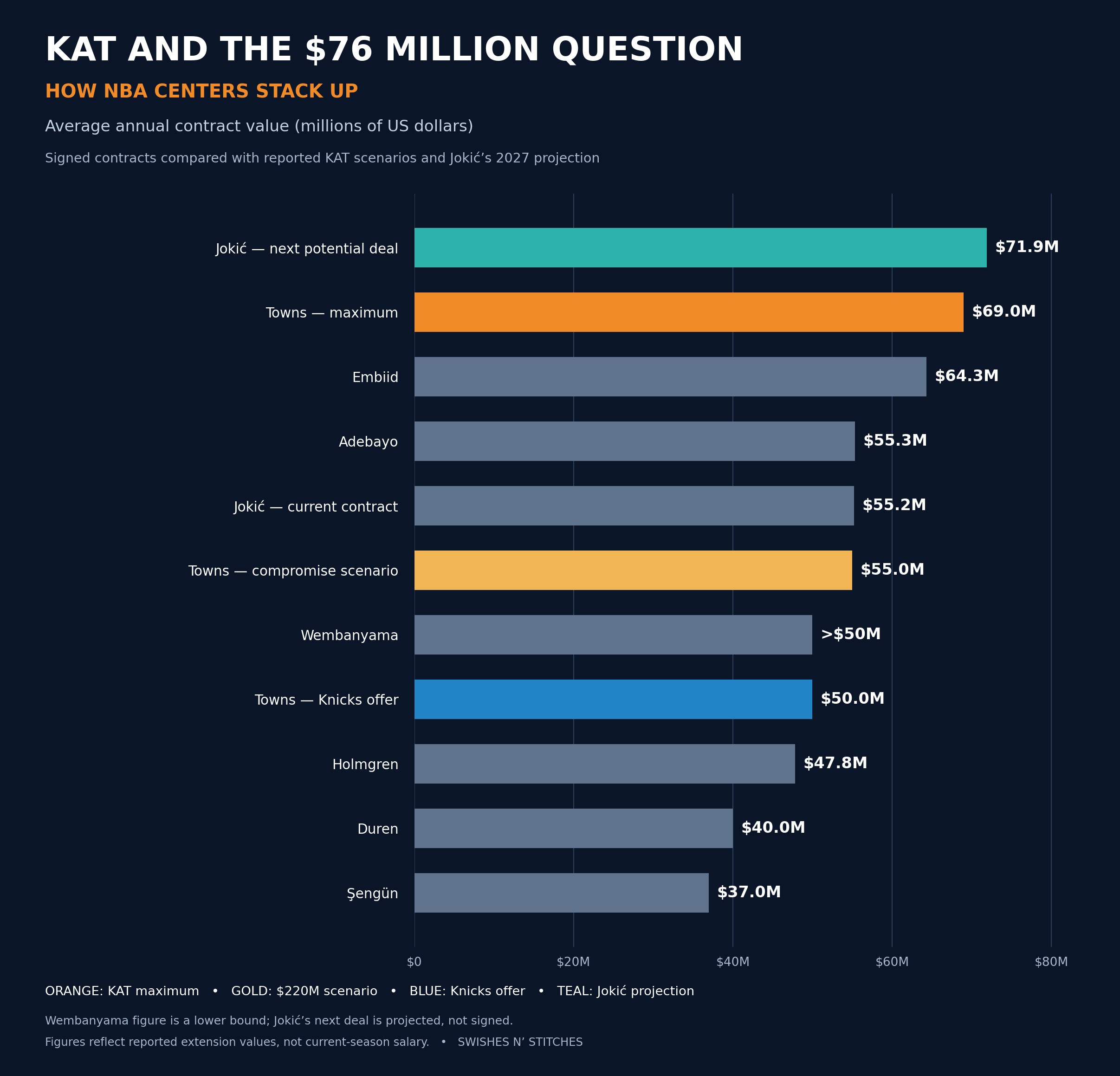
Jokić, a three-time MVP and NBA champion, is playing on a contract averaging approximately $55 million annually. He is eligible for a four-year extension worth approximately $278 million today, but is waiting until 2027, when he could potentially command five years and $359.5 million.
That’s nearly $72 million annually for arguably the best player in the world.
Now consider that Towns’ maximum extension would pay him approximately $69 million annually.
Are we really prepared to argue that KAT should be making almost as much as the next contract of a three-time MVP who routinely puts up triple-doubles?
Embiid, another former MVP, signed a three-year extension worth approximately $193 million, or $64 million annually. His talent is undeniable, but his injury history should give any organization pause before committing that amount of money to an aging center.
Wembanyama, arguably the most valuable young big man in basketball, reportedly agreed to a below-maximum extension that could exceed $250 million over five years. San Antonio’s generational superstar prioritized preserving financial flexibility to build around him.
And then there’s the younger generation.
Detroit committed $200 million over five years to Jalen Duren, a 22-year-old All-NBA center who averaged 19.5 points and 10.5 rebounds last season. Houston has Alperen Şengün, one of the league’s most talented passing big men, on a five-year, $185 million contract. Oklahoma City committed approximately $241 million to Chet Holmgren, whose defensive presence is central to the Thunder’s success.
Bam Adebayo provides another useful comparison. Miami committed $166 million over three years to one of the NBA’s premier defensive centers, putting his annual value around $55 million.
So where does Towns fit?
He has earned more than Duren or Şengün on an annual basis. His offensive versatility and championship contributions justify that argument.
But should he be paid more annually than Embiid, Jokić’s current salary, and virtually every other center in basketball?
I don’t think so.
A deal worth approximately $220 million over four years would put Towns at $55 million annually, almost identical to Bam’s average salary. That feels like a reasonable ceiling for a compromise, not necessarily the number New York should rush to offer.
Because while $220 million may be fair, the closer the Knicks can keep this contract to $200 million, the better.
That distinction matters far more than people realize.
The Case Against KAT: The Warning Signs Haven’t Disappeared
Winning a championship doesn’t erase a player’s weaknesses. It simply means the team found a way to overcome them.
And Towns still has some concerning habits.
First, the foul trouble.
During the 2025–26 regular season, KAT committed 255 personal fouls, the second-highest total in the NBA. He averaged 3.4 fouls per game and fouled out seven times.
The problem didn’t disappear in the postseason.
Across 19 playoff games, he committed 77 personal fouls, averaging just over four per contest. Combined with the regular season, that’s 332 personal fouls.
That is an alarming number for someone expecting a near-$70-million annual salary.
Foul trouble isn’t simply a personal statistical problem. It disrupts rotations, compromises defensive aggression, and forces coaches to make adjustments they otherwise wouldn’t need to make.
When Towns picks up two early fouls, the Knicks can lose some of the aggression that makes their frontcourt effective. When he collects his fourth or fifth, opponents can attack him differently, knowing another whistle could send him to the bench.
You cannot justify paying someone among the highest salaries in basketball if he repeatedly struggles to stay on the court during crucial stretches.
Second, the version of Towns we saw during the championship run needs to become the standard, not the exception.
Nobody is questioning his offensive talent. KAT has been an elite scorer for years. What has been questioned is whether he can consistently combine that talent with disciplined defense, mature decision-making, and reliable playoff execution.
His 2026 postseason was encouraging because he impacted games without needing to score 25 or 30 points. However, one championship run does not guarantee four more years of the same all-around production.
At 30 years old, turning 31 in November, the Knicks must consider whether they’re paying for his future or rewarding his past.
And then there is the $100 million question KAT has already answered.
In June, a clip circulated of Towns discussing whether he would consider sacrificing more than $100 million, much like Brunson, if it meant keeping a championship-caliber team together.
His response was that everyone would need to come together and agree to make that sacrifice.
Now, the original interview took place when Towns was still discussing keeping Minnesota together, not during these current Knicks negotiations. But the clip resurfaced this summer for a reason.
The philosophy he described is exactly what New York needs right now.
Brunson accepted a major discount to help this organization construct a championship roster. That decision helped make this moment possible.
Nobody should expect Towns to surrender $100 million simply because Brunson did. And I understand why a four-year, $200 million offer might feel disappointing when he’s currently making approximately $57 million annually.
But if KAT believes in collective sacrifice, this is his opportunity to put that philosophy into practice.
New York isn’t asking him to play for pennies. We’re talking about a contract that would still guarantee him hundreds of millions of dollars.
At some point, winning has to matter more than squeezing every possible dollar out of the organization.
The Bigger Picture: New York Cannot Mortgage Its Future
The Knicks are no longer rebuilding.
They’re defending champions with a veteran core, expensive contracts, and a limited window to maximize what they’ve assembled.
Brunson, Hart, Bridges, Anunoby, and Towns form an impressive foundation. They also represent an enormous financial commitment that will only become more complicated as the roster ages.
The league’s new collective bargaining agreement has made maintaining expensive teams considerably more difficult. Second-apron restrictions limit roster-building mechanisms and make trades, depth improvements, and long-term financial planning more challenging.
Owner James Dolan has made clear that he wants to avoid crossing that second apron.
We’ve already seen the consequences of that approach. Mitchell Robinson, a valuable defensive presence and longtime Knick, departed for Boston. Other important contributors, including Josh Hart and Miles McBride, face uncertain contract futures.
Brunson will eventually need another deal as well.
The Knicks cannot invest so heavily in keeping yesterday’s championship team together that they lose the ability to improve tomorrow’s team.
And this is precisely why the difference between $200 million and $220 million is important.
That additional $20 million represents approximately $5 million per season in average salary. Over four years, it is money that could help retain a rotation player, make room for a future acquisition, or reduce the financial pressure that forces championship teams to sacrifice depth.
The difference between the reported $200 million offer and KAT’s $276 million maximum is even more substantial: $19 million annually on average.
That is not pocket change under the NBA’s current financial structure.
A lower extension does not automatically create $19 million in usable cap space. But it can reduce the team’s tax burden, provide greater distance from the second apron, and preserve options that become increasingly valuable as this roster gets older.
And with fewer teams carrying significant cap space and major free-agent movement becoming more difficult, retaining financial flexibility has never been more important.
Which brings us to the Knicks’ biggest advantage.
The Verdict: The Knicks Have the Upper Hand
From a business perspective, I believe New York has the stronger negotiating position.
Towns has leverage. He holds a player option worth approximately $61 million for the 2027–28 season and can potentially enter free agency by declining it. The Knicks also understand that replacing his production wouldn’t be easy.
But where exactly is the market for a 31-year-old center demanding nearly $70 million annually?
How many teams have the financial flexibility, roster construction, and championship aspirations necessary to justify that commitment?
Not many.
And more importantly, how many of those teams offer Towns a better opportunity to compete for another championship than the one he already has?
New York offers a championship-tested roster, a superstar point guard, a national spotlight, and an organization with which he already has deep relationships.
Those relationships matter.
Knicks president Leon Rose previously represented Towns during his career at CAA. Towns is now represented by Jessica Holtz, another prominent CAA agent. Multiple members of New York’s championship core also have representation connected to that agency, including Brunson, whose agent Sam Rose is Leon’s son.
Those ties don’t guarantee a contract agreement, but they provide established channels of communication and trust that should help both parties navigate a difficult negotiation.
I believe they ultimately get something done.
My prediction: four years, approximately $220 million.
But let me be clear: that is my prediction, not my preferred outcome.
If I’m running the Knicks, I’m trying to keep KAT as close to that $200 million offer as possible.
A deal around $210 million would be better for the franchise. Getting him to accept $200 million would be better still.
Every dollar saved gives New York a little more room to retain its supporting cast, pursue roster improvements, and extend the championship window around Brunson.
Of course, that means asking Towns to accept less than he believes he’s worth. But championship teams require compromise, and I think the Knicks have enough leverage to demand it.
For a player who has already earned generational wealth and an organization worth billions, I refuse to believe the remaining distance between these two sides should be enough to jeopardize another championship opportunity.
Neither side needs to get everything it wants. Both sides need to protect what matters.
Towns gets long-term security, recognition, and compensation appropriate for an elite championship center. The Knicks maintain greater financial flexibility without alienating one of their most important players.
And everybody gets to move forward.
Because here’s what concerns me most: contract negotiations have a way of becoming locker-room problems when they’re allowed to linger.
The Knicks cannot enter their title defense with unnecessary tension hanging over the organization. They have already climbed the mountain once. Now every contender in basketball is studying how to knock them off it.
The last thing this team needs is to become its own biggest obstacle.
The diagnosis is straightforward. New York has a championship-caliber team with a financial problem that is entirely treatable.
The prescription? Compromise, secure the core, and get back to basketball.
Karl-Anthony Towns deserves to get paid. The Knicks deserve to protect their future.
Both can be true.
There is another championship to defend, and nobody in New York should be willing to sacrifice that opportunity over a contract dispute.
Coming next on Swishes n’ Stitches: The Knicks’ Prescription for a Repeat — a deeper look at the moves New York must make to defend its championship, starting with resolving the contract situations threatening to distract its title defense.
Gotham’s thoughts
Loading the discussion…