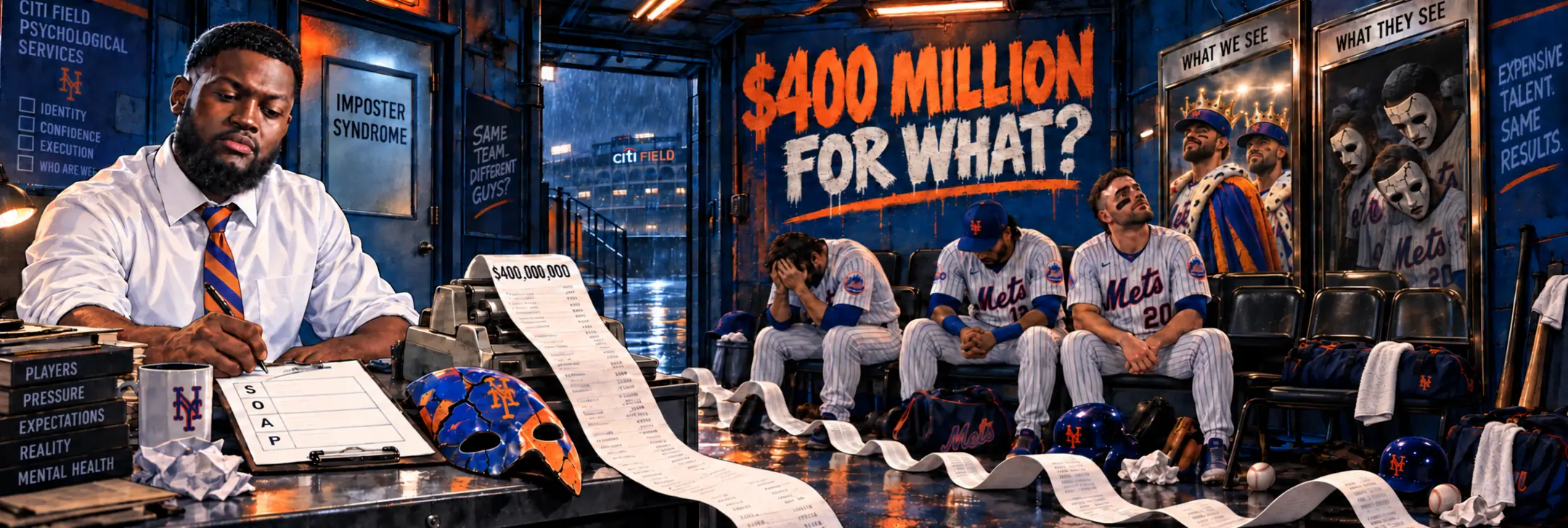
Patient: New York Mets Baseball Club
DOB: 1962
Residence: Queens, New York
Chief Complaint: “We spent nearly $400 million and still missed October.”
History of Present Illness
The New York Mets are a 64-year-old professional baseball organization presenting with another season of unmet expectations. The patient entered the year with Major League Baseball's second-highest payroll, multiple established stars and an owner willing to spend whatever was necessary to win. Despite those advantages, the Mets missed the postseason and once again left their fans trying to understand how so much money produced so little meaningful baseball.
This is not an isolated episode. The Mets have developed a pattern of collecting talent without building a complete team. Every offseason brings another signing, another press conference and another promise that Queens is ready to take over baseball. The roster looks impressive on paper. Expectations rise. Then the season begins, the pitching cracks, the depth disappears and the Mets start moving like somebody who got on the wrong train but refuses to admit it.
The most painful moment came when Pete Alonso returned to Citi Field wearing a Baltimore Orioles uniform and hit career home run No. 300. Bottom of the ninth. Game tied. Right there in Queens.
Alonso rounded the bases in Baltimore orange while the organization that drafted him, developed him and decided it could live without him watched from the other dugout. The Orioles eventually won in extra innings, because apparently watching Alonso make history was not enough. The Mets needed the full New York humiliation package.
That home run was more than bad timing. It was the slap in the face that happens when an organization drops the ball and stops being true to itself. Alonso came through their system, embraced the city, produced in October and became the franchise's all-time home run leader. Then the Mets let him leave. He returned home and reminded them exactly what they had thrown away.
New York has always been good at exposing imposters. You can dress like you belong, spend like you belong and talk like you belong, but eventually somebody asks you to prove it. You might fool tourists into paying $18 for a hot dog in Times Square, but the city itself is not easily impressed.
The Mets' problem is not a shortage of money or star power. Steve Cohen has given the franchise a financial advantage previous ownership never provided. Juan Soto is one of the best hitters alive. Francisco Lindor has proven he can handle New York and lead a contender. But two superstars and a massive payroll do not automatically create an identity.
The Mets have tried to purchase the finished product without establishing the foundation beneath it. Money can buy talent, depth and a larger margin for error. It cannot manufacture continuity, clubhouse chemistry or a clear organizational philosophy.
Relevant History
The Mets' own chart contains the treatment plan. Their strongest teams developed and retained a core, built around pitching and used outside acquisitions to finish the roster.
The 1969 Mets were powered by Tom Seaver, Jerry Koosman, Gary Gentry and a young Nolan Ryan. The lineup was not a collection of expensive celebrities assembled for a baseball reality show. It featured complementary players who understood their roles and trusted a dominant pitching staff to control games. The Miracle Mets knew exactly what they were.
The 1986 team had more star power, but its heartbeat still came from within. Dwight Gooden, Darryl Strawberry, Mookie Wilson, Lenny Dykstra and Wally Backman developed as Mets. Keith Hernandez and Gary Carter were added to strengthen something that already existed. They were not asked to manufacture culture from an empty clubhouse. The Mets built the core first and added the finishing pieces afterward.
The 2015 Mets followed the same formula. Matt Harvey, Jacob deGrom, Steven Matz and Noah Syndergaard formed a young rotation capable of suffocating opposing lineups. Jeurys Familia anchored the bullpen, while David Wright, Daniel Murphy, Lucas Duda and Michael Conforto gave the lineup continuity. Then Yoenis Cespedes arrived.
Cespedes did not give the Mets an identity. He gave an already dangerous team the extra offense it needed. The pitching was in place. The clubhouse had recognizable leaders. The Mets understood how they planned to win before he ever put on the uniform.
Even the 2000 Mets, who depended more heavily on outside additions, had a recognizable structure. Mike Piazza, Robin Ventura, Al Leiter and Mike Hampton were surrounded by Edgardo Alfonzo, Jay Payton and Benny Agbayani. That roster had starting pitching, defined roles and a clear plan. Those Mets spent money to complete a team. The current Mets spend money hoping a team will eventually appear.
That is the difference between acquisition and construction. Signing good players is not the same as building a good team, just as owning a stethoscope does not qualify some random man from Staten Island to diagnose passengers on the ferry.
Social History
The patient resides in Queens and maintains a complicated relationship with a loyal but emotionally exhausted fan base. Mets fans possess a high tolerance for pain and a concerning ability to interpret every April winning streak as evidence that this year might finally be different.
The patient also lives under constant comparison with the Yankees, the wealthy older relative who mentions past accomplishments at every family gathering even when nobody asked. That pressure has encouraged the Mets to prove their legitimacy through spending. But they do not need to become the Yankees or imitate the Dodgers. They need to understand what successful Mets baseball has historically looked like.
The fans are not angry because Cohen spends money. After years of ownership operating as if New York were a small market, nobody wants the Mets to become cheap again. The frustration comes from watching the organization spend without direction.
Objective Findings
The patient appears expensive, well marketed and appropriately dressed in blue and orange. Financial health is excellent. General appearance resembles that of a championship contender, although closer examination reveals poor structural alignment beneath the surface.
Payroll is significantly elevated. Expectations remain dangerously high. Fan patience is declining. The roster contains talented individuals but lacks enough connective tissue. Pitching depth remains weaker than it was during the franchise's healthiest periods, and homegrown continuity has eroded.
Alonso's 300th home run provided the clearest image of the condition: a homegrown franchise icon producing a historic moment at Citi Field for somebody else while the Mets absorbed the consequences of their own decision.
Diagnosis
Imposter syndrome of the New York Mets, chronic and currently uncontrolled. The Mets possess the external appearance of a championship organization without the stable internal identity of one.
Main Issue 1 — The Mets abandoned their historical formula.
Their strongest teams developed and retained a recognizable core, built around pitching and added outside stars only after establishing how they intended to win.
Main Issue 2 — The Mets are using money as a substitute for construction.
Cohen's spending is an advantage, not a disease. The problem is expecting money to create continuity, leadership, chemistry and organizational identity—things no contract can automatically provide.
The prognosis remains hopeful. The Mets have elite players, financial power and fans who continue showing up despite receiving the emotional equivalent of experimental treatment without informed consent. Recovery is possible, but only if the organization accepts the diagnosis.
Plan
The treatment is already in the patient's history: go back to what has worked. Build the foundation first, then use Cohen's money to strengthen it.
- Restore pitching as the franchise's backbone. The best Mets teams controlled games from the mound. Develop starters, add proven major-league arms and create enough depth that one injury does not trigger a crisis. Pitching must shape the roster from the beginning, not become an offseason afterthought.
- Build with Nolan McLean, not merely around him. McLean is the kind of young, homegrown arm the Mets should make central to their identity. Protect his development, give him a stable role and surround him with enough support that he becomes part of a staff rather than another prospect asked to rescue the franchise alone.
- Retain and develop the young outfielders. Identify which young outfielders can defend, hit and withstand New York, then give them a real runway to grow together. Do not block every path with a short-term veteran or trade young talent before it becomes part of the major-league culture.
- Keep Soto and Lindor at the center—not alone on the island. They can lead the next successful Mets team, but they need a young core, pitchers who establish the style of play and veterans with defined roles. Two stars should elevate the system, not become the entire system.
- Spend to complete the team. Use Cohen's money to retain proven homegrown players, acquire the final starter, deepen the bullpen and address specific weaknesses. The 1986 additions strengthened a core. Cespedes energized the 2015 core. That sequence matters.
- Make one season connect to the next. Fans should recognize the future and the plan even when a season gets difficult. Culture is not a slogan on the clubhouse wall. It is the result of consistent decisions and players developing together over time.
Progress should be judged by pitching stability, growth from McLean and the young outfielders, retention of productive homegrown talent and postseason performance—not payroll rankings or offseason headlines.
Develop the nucleus. Build around pitching.
Retain the players who embody the organization.
Then use Cohen's money to finish the job.
Money can buy better players. It cannot decide who you are.
The Mets do not need a smaller wallet. They need to look in the mirror, identify the imposter and remember who the hell they are.
The Gotham Sports Doc
Gotham’s thoughts
Loading the discussion…