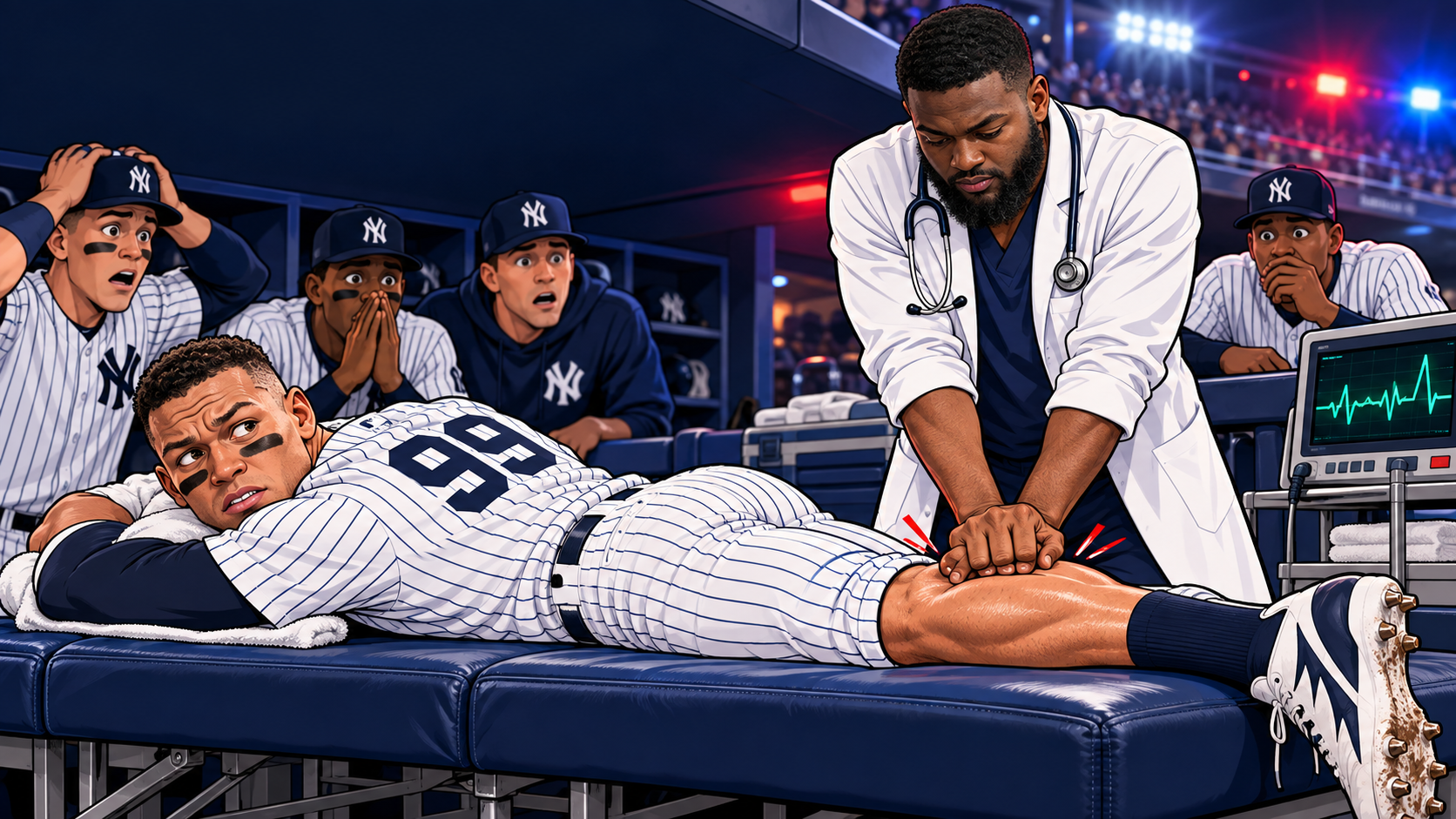
New York took three of four games from the Tampa Bay Rays, improved to 92–67 and produced two convincing offensive performances to close the series. The Yankees scored nine runs Wednesday and six more Thursday, demonstrating that this lineup can still function without Aaron Judge.
But Tampa Bay’s lone victory officially eliminated the Yankees from the American League East race. Instead of receiving a first-round bye, New York is now headed toward a best-of-three Wild Card Series against the Boston Red Sox.
Their captain may not be there.
Judge remains on the injured list with what Aaron Boone has described as a moderate strain of the soleus muscle in his right calf. Judge received a platelet-poor plasma injection Monday and was placed on limited activity afterward.
Boone said the Yankees are preparing as though Judge will not be available for the Wild Card Series.
Judge, unsurprisingly, has another plan.
The captain says he intends to return for Game 1. He believes he can get his body ready, step back into the middle of the lineup and help the Yankees begin their postseason run.
That disagreement tells us everything about the current condition of the Yankees. The medical staff sees a moderate calf strain with limited time to heal. The captain sees October approaching and refuses to remain below deck while his team tries to stay afloat.
The diagnosis is official:
Code Blue in the Bronx.
This Is Not an Ordinary Patient
This is not an ordinary injured player attempting to return.
This is Aaron Judge: the Yankees’ captain, the reigning American League MVP, a three-time MVP and an eight-time All-Star. He is a 6-foot-7 right-handed power hitter with 386 career home runs—the one player in the lineup capable of changing the diagnosis of a game with a single swing.
Judge has not produced his usual otherworldly numbers this season. Through 66 games, he is batting .241 with a .360 on-base percentage, a .511 slugging percentage, 18 home runs and 41 RBIs. After returning from the fractured rib that cost him more than three months, he went just 4-for-23 with one home run and 13 strikeouts.
On paper, that version of Judge may not look irreplaceable.
But Judge’s value cannot be looked at just by using his batting average alone.
Even when his timing is off, his presence changes the anatomy of the Yankees’ lineup. Pitchers know where he is at all times. They know when he is waiting in the on-deck circle. They know which hitters they cannot afford to walk before he comes to the plate. Opposing managers construct their bullpen plans around the possibility of facing number 99 with runners on base.
There is no magical force field called lineup protection, but there is an obvious difference between navigating the Yankees’ order with Judge waiting and navigating it without him.
His presence creates pressure before he ever enters the batter’s box.
The Yankees’ Vitals With and Without Judge
The numbers reveal how much the offense changes when its heartbeat is removed.
With Judge in the lineup this season, the Yankees have averaged 5.12 runs per game and produced a .764 team OPS.
Without him, those numbers have fallen to 4.23 runs per game and a .690 OPS.
That is a difference of nearly one full run per game.
The Yankees are also 41–25 with Judge, a .621 winning percentage, compared with 51–42 without him, a .548 winning percentage.
Over a complete 162-game season, those rates represent approximately the difference between a 101-win powerhouse and an 89-win Wild Card team.
Not every part of that gap can be attributed to one player. The quality of the opponents, injuries to other players and changes to the roster all influence team performance. But the pattern is too significant to dismiss.
Judge does not simply add his own home runs and RBIs.
He changes the circulation of the entire offense.
With Judge in the lineup, Ben Rice, Cody Bellinger and the hitters around them can remain within their individual roles. They do not have to manufacture Judge-sized production. A walk remains a productive plate appearance. A single keeps the inning moving. A solo home run adds to the attack instead of being expected to supply the entire attack.
Without Judge, every responsibility becomes heavier.
Rice is no longer simply one of the Yankees’ best young power hitters. He becomes the center of the offense. Bellinger is no longer a complementary veteran bat. He becomes one of the players responsible for replacing the most dangerous presence in the lineup.
No individual hitter can replace everything Judge provides.
Why His Right-Handed Bat Matters
Judge’s right-handed bat is particularly important in a lineup featuring several dangerous left-handed hitters, including Rice and Bellinger.
Without Judge, opposing managers can plan more comfortably for stretches of left-handed power. They can deploy their bullpen based on favorable matchups and attack multiple hitters with similar plans.
Judge disrupts that treatment protocol.
Placing his right-handed power between left-handed threats makes every pitching change more complicated. A left-handed reliever brought in to neutralize Rice or Bellinger may be forced to face Judge. A right-handed reliever selected specifically for Judge may create a more favorable matchup for the left-handed hitter behind him.
Judge makes opposing managers treat the Yankees’ lineup like a condition that cannot be managed with one medication.
His impact also extends beyond handedness. Pitchers cannot afford unnecessary walks with Judge approaching. They may attack the hitter in front of him more aggressively, creating better pitches to hit. If they pitch around Judge, he becomes a baserunner for the hitters behind him.
Either decision carries consequences.
That is how Judge helps the offense without recording a hit. He influences pitch selection, bullpen deployment and the level of stress placed on every pitcher who enters the game.
The threat of Aaron Judge can be almost as important as the production of Aaron Judge.
The Patient Is Still Fighting
To the Yankees’ credit, the offense responded against Tampa Bay.
New York opened the four-game series with a 2–0 victory behind eight scoreless innings from Carlos Rodón. The lineup then managed only one run in a 6–1 loss that allowed the Rays to clinch the division.
At that point, the Yankees could have emotionally flatlined. The division was gone. Judge was injured. Their postseason matchup was nearly established.
Instead, they responded with a 9–2 victory Wednesday and a 6–4 win Thursday.
Rice launched his 40th and 41st home runs of the season in Wednesday’s victory. The lineup demonstrated that it can still generate power, build innings and provide enough support for one of baseball’s strongest pitching staffs.
The Yankees went 3–1 against the team with the best record in the American League and outscored Tampa Bay 18–12.
That matters.
This is not an obituary for the Yankees’ season. The patient still has a pulse, and it is stronger than it appeared after consecutive losses in Arizona.
But beating Tampa Bay three times does not make Judge expendable. It proves that the Yankees are capable of surviving without him.
Survival and championship contention are not the same diagnosis.
Wednesday’s nine-run eruption represents the ceiling of the Judge-less offense.
Tuesday night’s one-run performance represents the danger.
In a three-game Wild Card Series, the Yankees do not have time to wait for the better version to appear.
Why the Soleus Is So Difficult to Manage
The soleus does not receive the attention given to the hamstring, Achilles tendon or gastrocnemius—the larger, more visible calf muscle. It sits deeper in the lower leg, beneath the gastrocnemius, and joins it near the Achilles tendon.
Its primary action is plantar flexion: pressing the foot downward, like stepping on a gas pedal.
That movement is involved in nearly everything Judge must do on a baseball field. The soleus helps stabilize the lower leg, maintain balance, accelerate, decelerate and push the body forward when the knee is bent.
For Judge, the strain is in his right leg—the back leg in his right-handed batting stance. That leg helps him remain grounded and transfer force through his lower body during the swing. The muscle is stressed again when he leaves the batter’s box, rounds a base, changes direction or slows down in the outfield.
That makes a soleus strain particularly deceptive.
Judge might feel comfortable walking or taking controlled swings while the muscle remains unprepared for the unpredictable demands of a game. Hitting in a cage is not the same as reacting to a 98-mph fastball, driving through the back leg and immediately sprinting toward first base.
The soleus is also highly active during prolonged weight-bearing. Judge could tolerate a brief workout before experiencing symptoms as the intensity or duration increases.
Passing one rehabilitation test does not mean he is ready for all of them.
In October, “almost ready” is still injured.
What “Moderate” Means
The Yankees initially refused to disclose the severity of Judge’s strain. Boone has now called it “moderate,” which provides more information but still does not establish an exact return date.
Muscle strains are commonly divided into three grades.
A Grade 1 strain involves relatively minor damage to a small number of muscle fibers. Even these injuries can require approximately two to three weeks before an athlete is prepared for unrestricted competition.
A Grade 2 strain is a partial tear involving more substantial fiber damage, weakness and functional limitation. Recovery often requires several weeks and can extend into the five-to-eight-week range.
A Grade 3 strain is a severe or complete tear that may require several months of rehabilitation.
The Yankees have not officially assigned Judge’s injury a numeric grade. However, describing it as moderate raises more concern than the minor Grade 1 injury fans may have initially hoped for.
Judge received a platelet-poor plasma injection as part of his treatment. That injection should not be interpreted as proof that he will be ready quickly. It is one component of his management. His return must still be determined by pain, strength, range of motion and his ability to tolerate baseball-specific activity.
The calendar is working against him.
The Wild Card Series is approaching, and a moderate soleus strain does not become mild simply because the Yankees need their captain.
Judge Plans to Answer the Code
Boone says the Yankees are preparing for the Wild Card Series as though Judge will not be available.
Judge has other plans.
If Judge can will himself back onto the field, his return could provide exactly the type of resuscitation this Yankees offense needs. Imagine Yankee Stadium erupting as number 99 walks toward the batter’s box after everyone had prepared for him to remain sidelined.
Before taking a single swing, Judge would restore confidence to the dugout and force Boston to reconsider how it approaches every hitter around him.
In a Code Blue, everyone looks for the intervention capable of restoring the patient’s pulse.
For the Yankees, that intervention is Aaron Judge.
His return would not guarantee victory. He could remain rusty. His timing could still be off. He might be unable to run at full speed or produce his normal power through the injured leg.
But his name in the lineup would immediately change the emotional temperature of the series.
There are few players in baseball whose presence alone can do that.
Judge is one of them.
But Is an October Return Worth the Risk?
The physician’s responsibility is not merely to restart the heart. It is to ensure that the attempted treatment does not create another emergency.
That is the question the Yankees must answer:
Would bringing Judge back provide life-saving treatment—or expose him to an even more devastating injury?
The soleus does not function independently. It joins the gastrocnemius to transmit force through the Achilles tendon. When Judge drives through his back leg, pushes out of the batter’s box, accelerates toward first or suddenly changes direction, the entire calf-Achilles complex must absorb and transfer tremendous force.
A healing soleus may not be capable of carrying its normal share of that load. Pain, weakness or subconscious guarding could alter Judge’s mechanics and redistribute stress throughout the lower leg.
The most clearly established danger is aggravating the current strain or suffering another calf injury. An Achilles rupture is not inevitable, and the available medical evidence does not prove that returning from a soleus strain directly causes one.
But the anatomy makes the concern impossible to ignore.
The gastrocnemius and soleus merge into the Achilles tendon. If Judge returns before restoring his normal calf strength, flexibility and load tolerance, his lower leg may be forced to manage explosive stress without its usual protection.
For a 6-foot-7, 282-pound athlete, those forces are not insignificant.
An Achilles rupture would transform the Yankees’ current Code Blue into a long-term medical crisis. It could require many months of rehabilitation and potentially affect Judge well beyond this postseason.
That is an enormous risk for a 34-year-old franchise player.
If Judge demonstrates normal strength, pain-free running, full-speed acceleration and the ability to recover after repeated baseball activity, then his return could be the shock that brings the Yankees’ offense completely back to life.
But determination cannot substitute for healed tissue.
October adrenaline can suppress pain. It cannot restore damaged muscle fibers.
Judge may be able to will himself back into the lineup. The Yankees must determine whether his body is truly prepared to follow him there.
The Boston Problem
The Yankees are positioned to host the Red Sox in the Wild Card round.
That matchup makes Judge’s availability even more important.
Boston is not an unfamiliar opponent that might be overwhelmed by the moment or intimidated by Yankee Stadium. The Red Sox understand the environment, the rivalry and the pressure attached to postseason baseball in the Bronx.
A short series against Boston can turn on one mistake, one bullpen decision or one swing.
Judge is the hitter most capable of delivering that swing.
His presence would force Boston to account for him even if he were not fully healthy. His absence allows the Red Sox to attack the rest of the lineup without navigating around the largest threat in the order.
The Yankees have enough starting pitching to win without Judge. Rodón, Max Fried, Gerrit Cole and Cy Young candidate Cam Schlittler give New York the ability to control games from the mound.
But a dominant rotation still needs oxygen from its offense.
Two runs may be enough when Rodón throws eight scoreless innings. It may not be enough when the opposing starter is equally sharp or when one mistake reaches the seats.
Stable Is Not the Same as Healthy
The Yankees proved something important against Tampa Bay.
They are not helpless without Judge.
Rice has developed into a true power threat. Bellinger remains capable of carrying the offense for stretches. Spencer Jones and George Lombard Jr. have provided youth and energy. The pitching staff is strong enough to keep almost any game within reach.
The Yankees can survive without their captain.
But October is not about survival. It is about beating elite teams before they identify and exploit your greatest vulnerability.
Without Judge, the Yankees must operate close to perfection. Their starters must control the game. Their bullpen must preserve every lead. Their remaining hitters must convert the limited scoring opportunities that playoff pitching provides.
With Judge, one swing can correct several mistakes.
Without him, every mistake remains on the chart.
The Yankees do not merely lose Judge’s home runs when he is unavailable. They lose his walks, his patience, his presence, his right-handed balance and the psychological weight he places on an opponent.
They lose the hitter capable of changing the prognosis of a game before the ball ever leaves his bat.
New York’s vital signs improved against Tampa Bay. The Yankees won three games, rediscovered their offense and reminded the American League that their season is still alive.
But the diagnosis has not changed.
Their captain is down. Their toughest test is approaching. The medical staff is preparing for him to remain unavailable, while Judge is racing against biology to prove otherwise.
It remains a Code Blue in the Bronx.
The Yankees have shown that they can keep the patient alive without Aaron Judge.
Now they must decide whether bringing back their heartbeat can save October—or create an emergency that lasts far beyond it.
The Gotham Sports Doc
Gotham’s thoughts
Loading the discussion…